Price Ceilings
Press for different diagrams
Price Ceiling & Market Outcomes

Diagram Explanations:
-
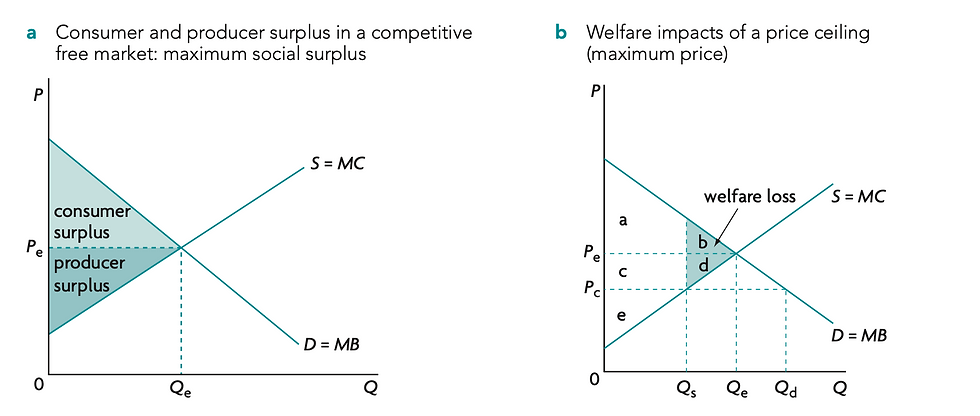
Initially, mkt equilibrium is at the point where D and S intersect, with equilibrium price and quantity Pe and Qe -> some hospitals in Indonesia charged COVID-19 swab tests over Rp 2.5 million -> price is too high & becomes unaffordable for low-income consumers -> swab test is a necessity to test whether one is sick -> a price ceiling Pc of Rp 900,000 for COVID-19 swab tests is imposed in Indonesia (Oct 2020) to address cost disparities at private labs -> Pc is set below the equilibrium price Pe so:
-
Lower price at Pc -> producers receive less revenue and profit -> less incentivized to produce -> quantity supplied contracts from Qe to Qs
-
Lower price at Pc -> swab tests become more affordable as its cheaper -> more demands -> quantity demanded expands from Qe to Qd
-
As a result, creates a shortage (Qd-Qs) in the mkt.
Before Pc:
CS = a+b
PS = c+d+e
TS = a+b+c+d+e
After Pc:
CS = a+c
PS = e
DWL = b+d
Effects of a Price Ceiling on Consumer & Producer Surplus
Evaluation for diff stakeholders:
1) Consumers
-
Consumers that purchase the good -> pay lower price (Pc) compared to Pe -> better-off
-
Necessities are more affordable for these consumers -> decrease costs of living -> increase their disposable income -> improve living standards
-
-
Pc leads to fall in quantity supplied -> some consumers may not get to purchase the good -> worse-off
-
Represented by loss of consumer surplus by area b
-
Necessities → relatively more inelastic demand
-
CON: Left-out consumers may need to purchase the necessities from black markets to ensure survival
-
2) Producers
-
Legal Producers: as Pc set below Pe -> price per good received decreases -> producer revenue & profit decreases -> worse-off
-
Represented by a loss of producer surplus by area d
-
Necessities have inelastic demand -> when price decreases, producer total revenue decreases too -> worse-off
-
-
Illegal producers: left-out consumers who can afford higher prices buys from the illicit mkt -> increased consumption in black mkts -> increased quantity sold (while at a higher price than price ceiling) -> increase in producer revenue & profit -> better-off
-
CON: Bc of this, more legal producers may switch to selling in black mkt -> fuels illicit markets
-
3) Government
-
PRO: gains political support from especially low income households
-
CON: increases maintenance costs for the government in combating the black markets
Welfare Analysis: