Price Floor
Press for different diagrams
Price Floor/Min Wage & Market Outcomes

Price Floor
-
Initially, the market is at equilibrium where demand (D) and supply (S) intersect, with equilibrium price and quantity Pe and Qe -> -> Pf set above the equilibrium price Pe , so:
-
Higher price at Pf & if gov buys surplus, they don’t lose any revenue -> producers receives more revenue & profit per unit sold -> incentivized to produce more outputs -> quantity supplied expands from Qe to Qs
-
Higher price at Pf -> g&s becomes less affordable for consumers -> consumers buys less -> less demands of g&s -> quantity demanded contracts from Qe to Qd
-
As a result, creates a surplus (Qs-Qd) in the mkt.
Diagram Explanations:

Minimum Wage
-
Initially, the labor market is at equilibrium where labor demand (D) and labor supply (S) intersect, with equilibrium wage We and equilibrium quantity of labor Qe -> the California gov increased the minimum wage from US$16.50 per hour (Jan 2025) to US$16.90 per hour (Jan 2026) to improve the income and living standards of low-income workers, as the cost of living in California is relatively high -> minimum wage (Wf) is set above the equilibrium wage (We), creating a binding price floor, so:
-
Higher wage at Wf -> workers receive higher income per hour worked -> more individuals are willing to work or existing workers are willing to work more hours -> quantity of labor supplied expands from Qe to Qs
-
Higher wage at Wf -> employing workers becomes more costly for firms -> firms reduce hiring to lower production costs -> quantity of labor demanded contracts from Qe to Qd
-
As a result, creates a surplus of labor (Qs-Qd) in the mkt.
Diagram Explanations:
Effects of a Price Floor/Min Wage on Consumer & Producer Surplus
Price Floor

Before Pc:
CS = a+b+c
PS = d+e
TS = a+b+c+d+e
After Pc:
CS = a
PS = b+c+d+e+f
Gov = c+e+g+f
TS = a+b+d-g
DWL = c+e+g
Welfare Analysis:
Minimum Wage
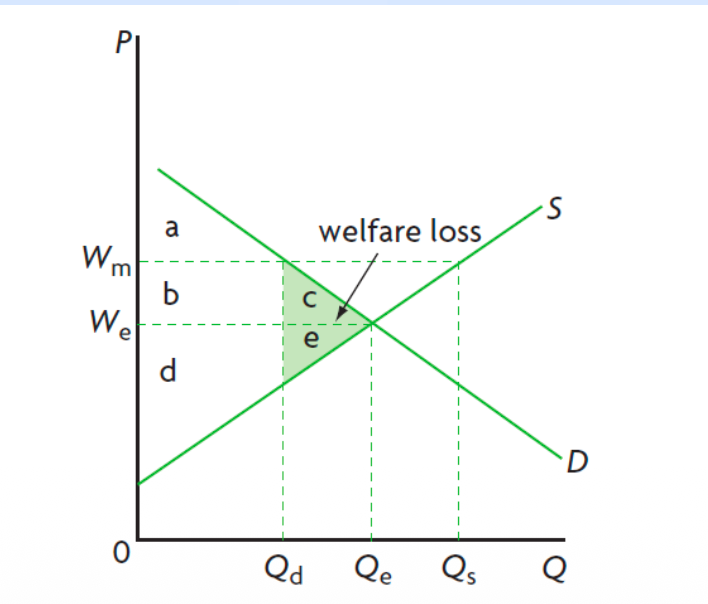
Before Pc:
CS = a+b+c
PS = d+e
TS = a+b+c+d+e
After Pc:
CS = a
PS = b+d
TS = a+b+d
DWL = c+e
Welfare Analysis:
Evaluation for diff stakeholders:
1) Workers:
-
Raised wages -> more disposable income -> higher purchasing power -> afford more g&s -> living standards is raised
2) Producers:
-
Raised wages -> incentivize workers to work more productively & efficiently -> more outputs produced -> may benefit from economies of scale
If govt does not buy surplus:
1) Consumers:
-
Raised prices of g&s -> consumers must pay higher price than before to buy goods -> reduces purchasing power -> consumers worsens off
-
If good is inelastic such as food -> harming low-income households severely as they must buy to maintain basic survival
-
2) Producers:
For legal producers:
-
Sell at higher prices -> more revenue & profit made each unit sold -> better off
-
However, quantity sold decreases with higher prices -> worsens off
-
Since Qd < Qs creates surplus -> surplus increases in LR -> without gov buying surplus -> producers struggle with overproduction -> may need to spend extra costs on dealing with the excess supply
-
e.g storing/exporting in cheaper prices to foreign countries
-
For illegal producers:
-
Qsold is lower because of higher price and lower demand -> producers might sell excess supply in black markets at a lower price than the Pf -> consumers may seek more cheaper goods so buy in black markets -> earning revenue & profit -> better off
-
However, fuels illicit markets
3) Government:
-
Increase cost to combat with black markets => opportunity costs in giving other welfares (better healthcare/education) to the society => gov worsens of
If govt does buy surplus:
1) Consumers:
-
Even though price is higher (Pf) -> gov purchasing surplus prevents shortages -> stable supply in market -> everyone has access to the good => benefits if goods in price inelastic -> better off
-
Higher cost of living -> lowers affordability -> living standards decreases -> worsens off
2) Producers:
-
Producers can sell all their output at higher price (Pf) as gov buys surplus -> removes risk of unsold stock -> stable revenue earned and income -> better off
3) Government:
-
Spend gov revenues on buying surplus and need to spend extra costs exporting/storing -> opportunity costs & may run out of budget in the LR -> possibility of budget deficit -> worsens off
4) Society:
-
After a binding price floor:
-
In the labour market, too few jobs are created.
-
In the goods market, too many goods are produced.
-
-
Allocative inefficiency